- contact@insightclickiq.com
- Every click, every session, explained by AI

Agents
An analyst that shows every step
Give an agent a goal or a playbook. It works breadth first, then depth, calling the same tools you use, and concludes with findings that point at their evidence.
The run
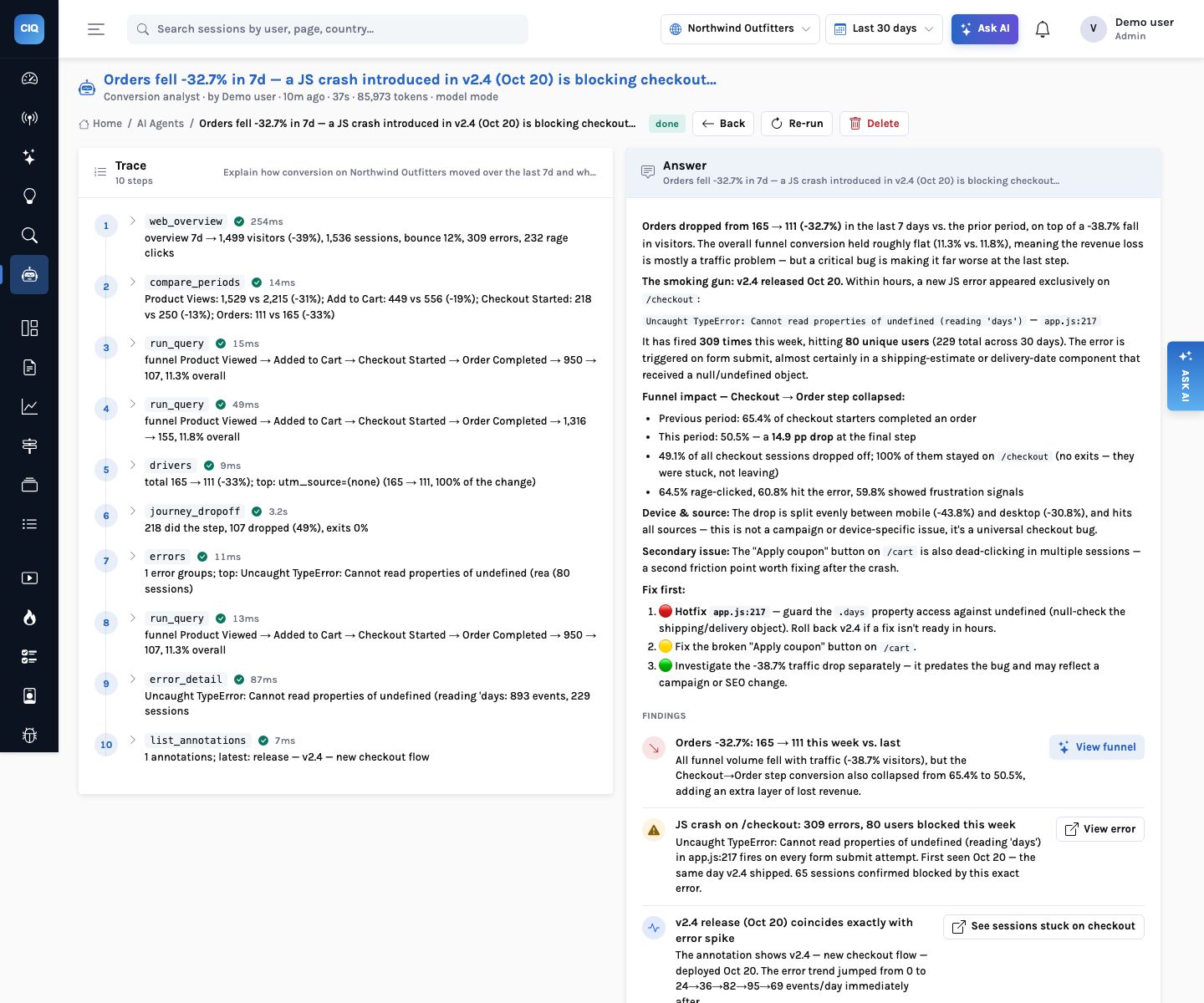
The trace on the left, the conclusion on the right
Each step is recorded the moment it happens and streamed to the page: the tool, its arguments, a one-line summary of the result, the milliseconds and whether it succeeded. The answer has a headline, up to six findings with links into the console, the charts and session lists from the steps it chose to show, and follow-up questions.
- Breadth first: overview and period comparison, then drivers
- Depth next: journeys, zones, forms or errors, whichever the evidence points to
- Proof last: sessions to watch, or an investigation over many of them
- At most 12 tool calls by default (20 at most) and a 150-second budget; an identical call is refused with a pointer to the earlier step
Playbooks
Nine playbooks, each schedulable daily or weekly
A signal’s “Analyze with an agent” picks the right one: frustration goes to the Frustration hunter, an error spike to Error triage, a conversion drop to the Conversion analyst, a slow page to Page audit.
| Playbook | What it looks at |
|---|---|
| Conversion analyst | Conversion against the previous period, drivers, the funnel and the sessions that dropped |
| Frustration hunter | Rage and dead clicks, the zones that cause them and the sessions behind them |
| Traffic analyst | Sources, campaigns, countries and devices that moved, and whether conversion moved with them |
| Page audit | One page: its zones, scroll reach, vitals and errors |
| Journey explorer | Patterns, golden paths, loops and the biggest drop-off |
| Error triage | The top error (or a given fingerprint): trend, pages, browsers, sessions affected |
| Form doctor | The worst form: drop-off field, slow fields, refills, errors |
| Weekly review | The week across traffic, conversion, signals and quality (scheduled weekly by default) |
| Install health | Is the snippet sending what it should: custom events, identify, vitals, forms, replay coverage (daily by default) |
How it works
The agent loop: plan a call, run it through the registry, record the step, repeat, then finish with evidence
What you can ask
Questions this answers
Type them into Ask, give them to an agent as a goal, or send them through MCP from your own assistant.
Why did checkout conversion fall after the v2.4 release?Conversion analyst: drivers, funnel, errors, sessions
Which element frustrates people most this week?Frustration hunter: the rage and dead zones with sessions
Audit /products/NW-JKT-001Page audit: zones, scroll, vitals and errors for one page
What is the most common path to a purchase?Journey explorer: golden path and the biggest drop
Is our tracking healthy?Install health: what is missing, as tips
Review the weekWeekly review, delivered on a schedule
Outcomes
What teams do with it
A second analyst on call
Playbooks run daily or weekly on a schedule and leave a finished run to read.
Reasoning you can audit
Every claim traces to a step; every step shows its arguments and result.
Action from the finding
Findings link to the console screen, or create the dashboard, segment or alert for an editor.
Where it stops. An agent is bounded by its tools and its budget: it reads your analytics, not your code or your CRM. It concludes from what the tools returned; if a question needs data that was never captured, the answer says what is missing.